From Coverage to Connection
When time, not learning, becomes the focus

After a couple of weeks off to welcome spring, I’m back at it, intending to continue sharing a couple of posts a week. I hope they will stimulate your imagination or raise your hackles. Either way, if we can think together about learning and schooling then I’m happy.
This post has only been very, very lightly touched by AI. I wrote the entire draft and then asked it to just identify any blatant spelling or grammatical errors. It redid spacing, but very few other changes. I’m going to include my new “mark” (†) at the end to denote that there was an AI contribution.
—
This is an exciting time of year for educators. The snow is (mostly) gone from northern schools. Here in Chicago, the trees are budding and flowers are pushing up. And of course, it’s Spring Break season.
Most colleges and universities are already past their breaks. Now it’s time for K–12 schools. These breaks are part of what marks the rhythm of the year. You know the pattern. The start of school in late summer or early fall, then fall break, Thanksgiving, winter holidays, spring break, and finally the end of the academic year.
In the middle of February, Spring Break feels far away, but thank goodness, it eventually rolls around. But then the excitement shifts.
Students eye the calendar, and after Spring Break it’s common to start counting down the days until summer vacation. Teachers and professors eye the calendar too, but often with a different reaction. They aren’t just looking at the traditional calendar—they are looking at their curriculum map, their syllabi, the fast approach of finals. And a sense of panic can begin to set in.
I don’t know any teachers in a traditional classroom who, in September, wonder how they will ever find enough material to last the whole year. Quite the opposite. In September, teachers look at the syllabus and think, Of course I can cover everything the department or district is requiring. But then absences build. Interruptions creep in. A cancelled class here. A shortened period there. It adds up.
By early April, excitement has shifted—read: panic.
Then it becomes a matter of discarding. What topics or assignments can I sacrifice and still feel like I’ve given students what they need to move on?
But what if courses were not something to “get through” by the end of the term? What if they were part of a larger on-going element in the larger learning process? It really seems rather ridiculous to me that we give students the idea that learning “ends” at a given point. Courses should not be seen like a set of some sort of academic lego blocks that go into a big pile and you hope that someday you can build something useful outof them.
Along with that, the older I get, the more I find myself questioning traditional notions of assessment. Most of the assessments I’m familiar with have been assessments of products. They are used to validate the lego blocks not to chart an individual learner’s journey.
“Do this assignment, then I’ll grade it.” “Write this term paper—in class and longhand so I know you didn’t use AI.” “Turn in this project on the Gilded Age.” “Get everything in by the end of the term so I can give you a grade.”
Keep up. Keep up! KEEP UP!!
What if we looked at education as something besides a transaction—the exchange of tokens? What if did away with a transactional approach — I turn in these products, and you give me a grade.
What if education was about the relationships between ideas and people—across disciplines, across experiences, across time? What if the focus was on charting and seeing evidence of a learner’s development over time? What if the characteristics in a Portrait of a Learner were what we truly got excited about?
That’s part of the fundamental difference. School and grades are almost entirely about transactions—the exchange of products for tokens. Learning is about relationships and different ways of seeing and understanding.
The fact that we continue to rely on false proxies of learning—grades based on products—is both understandable and inexcusable. In 2026, we have much better ways of encouraging and validating learning.
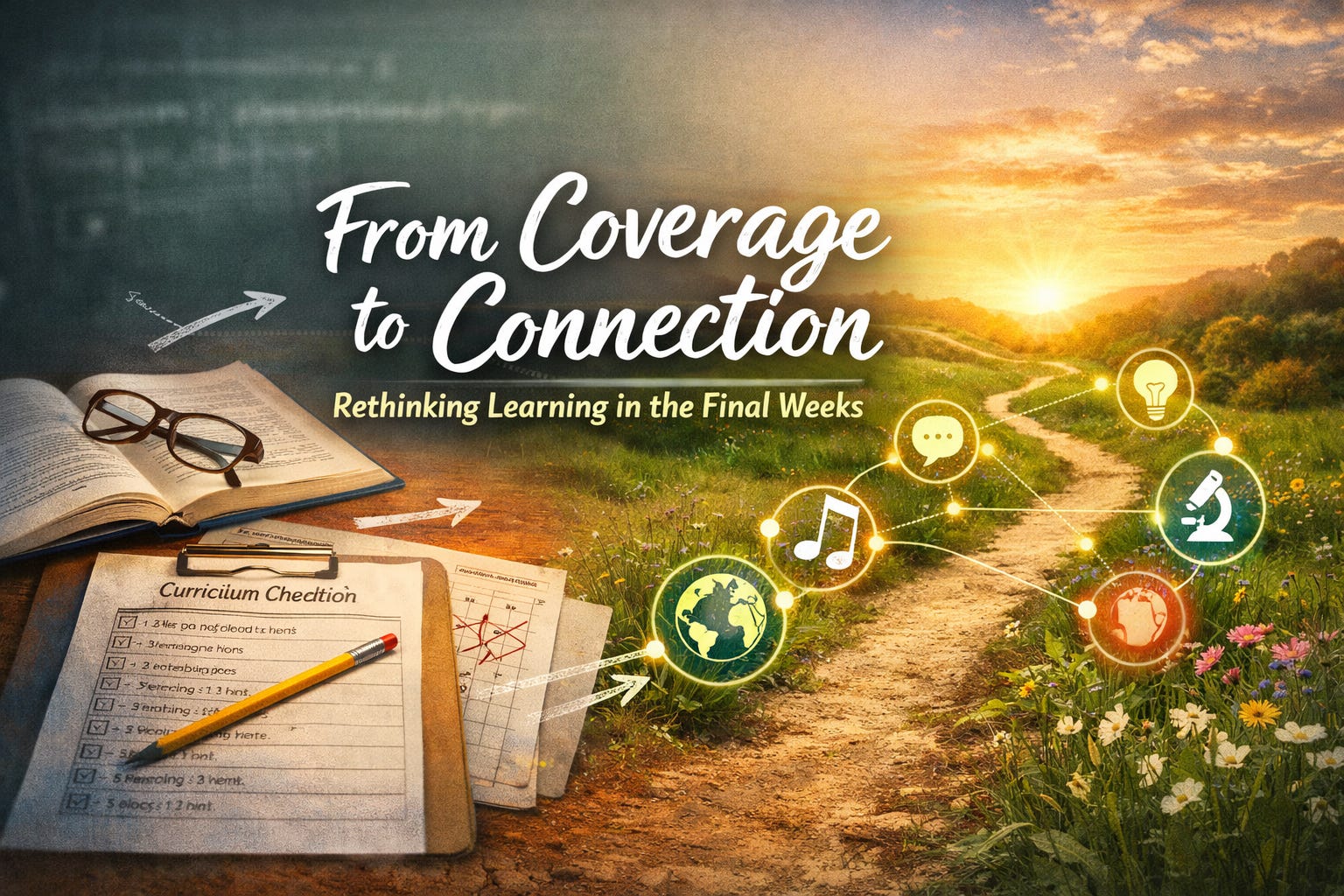
What would it look like to shift—even in these final weeks—from coverage to connection?
Not a full redesign. Just one move. One piece of evidence that captures a learner’s growth over time. One moment where the focus isn’t on finishing the course, but on noticing the learning, and making connections across courses, years and people.
Nothing about the use of AI to hide here. The image for the post was fully AI generated (ChatGPT) but the writing in the post is mine — with only very slight AI oversight (mostly spacing) — I’m using the AI† to let readers know.