Learning Is Not A Perishable Good
What carrots, calculus, and meaning reveal about memory

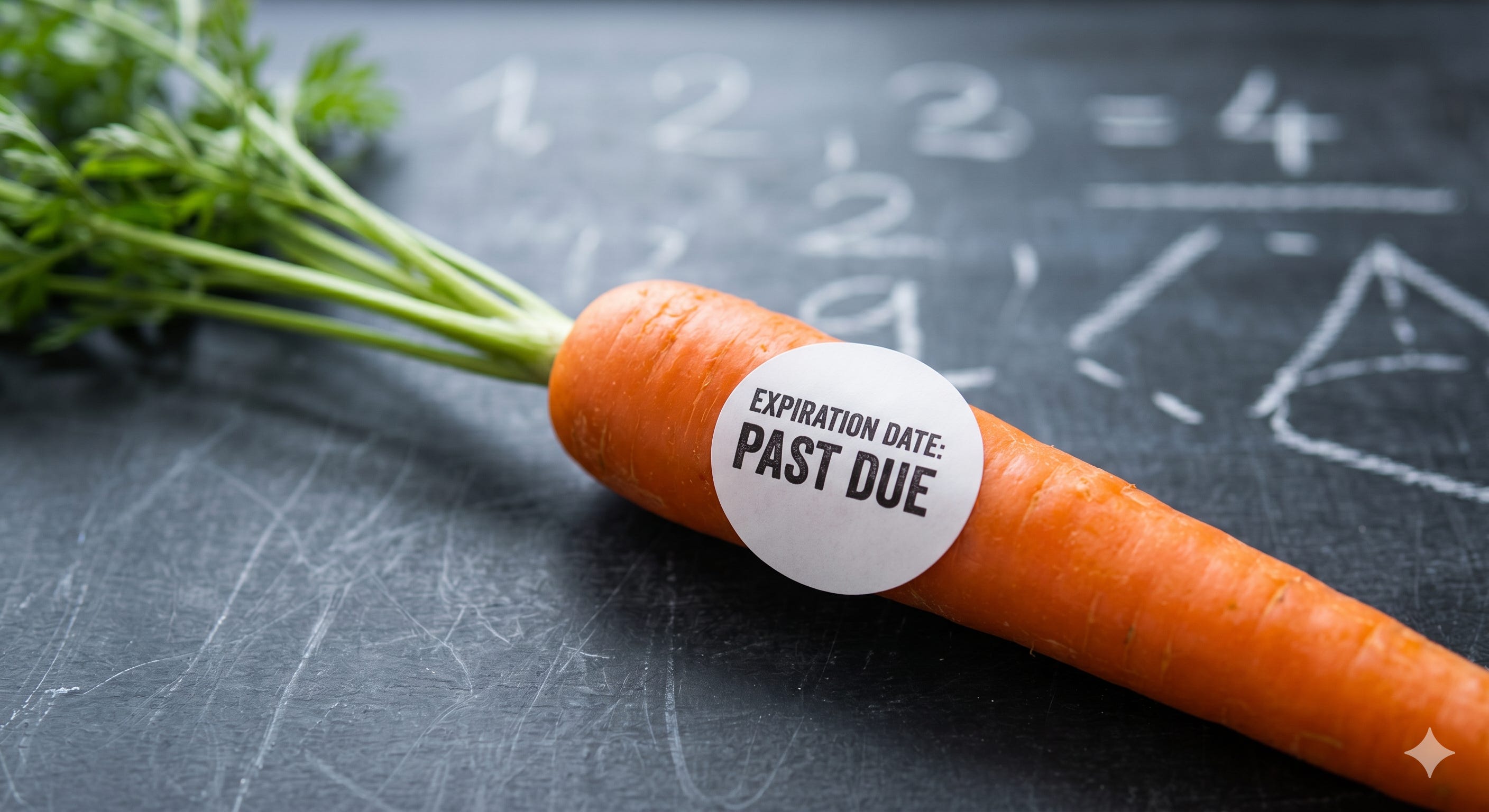
In my previous Substack post I wrote about the need to “disturb the universe”, step back and challenge some of our unexamined thoughts about assessment. Once we have accepted the need for an organized model of instruction (lessons, chapters, units, courses, grade levels/majors) then it makes sense that at each step along the way we check for understanding before we go on.
Why doesn’t that work?
Why is it that weeks later some students have trouble remembering concepts or procedures that they had previously successfully recalled or demonstrated? Why did I often overhear math teachers say “These students are struggling in Algebra II because they don’t even know concepts from Algebra I”? We’ve shortened summer breaks, with some schools even going to “year round school” in an attempt to combat summer slide or summer learning loss. Wouldn’t it be nice if that slump didn’t occur?
What if forgetting is not the real problem?
Seriously, what’s going on?
I don’t think this is a teacher issue – teachers I’m familiar with use the latest research on spaced repetition, retrieval practice, interleaving, dual coding, etc. It has improved results for those who faithfully employ these well-grounded techniques, and yet . . .
Maybe it helps to think about it in terms of something we all know – food! There are some things that are touted as being good for me that I steer away from – cottage cheese would be top of that list, along with kefir yogurt and a few other things. I just don’t like them no matter how “healthy” they may be. Nevertheless I try to be a relatively healthy eater. But every once in a while I give in to some ultra-processed concoction, like potato chips or a snack cake. They just seemed so enticing – the packaging is alluring — you can pass by them in the grocery store again and again and then you give in. But then are foods that are considered “staples” such as bread or milk.
In school, there are some courses that are required – no choice involved. These are your minimum daily requirements in a school setting. Those requirements are going to include some of the personally unpalatable. If a teacher sees you’re struggling with them they’ll do their best to make them easier to swallow.
Same meal. Different learner. Different result.
For some reason my brother hated carrots so our mother would sometimes sweeten them when she cooked them and then he’d at least agree to swallow those candied carrots. He somehow managed to clean his plate, despite his dislike of the offering. We talked about it one day and he told me he hasn’t eaten a carrot in any form since, raw, cooked or sweetened.
But guess what – he absolutely loves Brussels sprouts! Strange isn’t it? It wasn’t that he didn’t like vegetables, he just didn’t want or need carrots in his life. Still doesn’t – he gets along just fine without them.
School centers content. Learning centers people.
I recently read Putting Ourselves Back in the Equation: Why Physicists Are Studying Human Consciousness and AI to Unravel the Mysteries of the Universe (2023) by George Musser. Musser suggests that modern physics increasingly reminds us that observer, context, and relationship matter. Yet school often behaves as if knowledge exists apart from the learner: curriculum exists “out there,” teachers deliver it, students receive it, and identical inputs should produce identical outcomes. The tension between those two ways of seeing is hard to miss.
Now think about this with my brother’s carrots. Theoretically at least he and I were being given the same portions and the same nutrients at the same meal. I still love carrots to this day and I actually prefer them un”candied”. Yet he resisted them, swallowed reluctantly and has not touched them since. Same content, same delivery, different results because of our individual differences.
The missing variable may be the learner.
Extending Musser’s thinking, it’s the student that matters first and foremost, not the content. Yet in school we organize everything around the content and student choice isn’t really very important. It’s folly to believe that isolated parts can be deeply understood and retained when they are presented in isolation – How many times did your algebra teacher ask you to look at your French assignment through the lens of mathematics? The problem is structural, not personal. In the same way it wasn’t our mother’s fault that my brother didn’t like carrots.
Let’s return to the perishable goods idea that I started with. Because schooling insists that knowledge can exist independent from the learner, we have adopted the unquestioned practice of always putting an expiration date on it. Students might not remember important concepts or ideas after the test, or after the course but it has little to do with the instruction. We’ve trained students to be very careful shoppers – they look at the expiration dates and pay attention to them. It highlights some of the shortcomings of both traditional and “alternative” assessments.
Some expiration dates become identities.
The cost of that thinking lasts far beyond school. Many adults quietly carry the belief that they were never good at math, science, languages, writing, or history. Often what they were really “bad at” was learning those subjects on someone else’s timetable, in someone else’s format, for someone else’s reasons. They confuse a school experience with a permanent verdict about themselves.
Sometimes the assignment is not the real learning target, but that’s what we assess.
My mother might have told my brother “Eat your carrots – they’re good for you!” but what she really meant was that a healthy diet includes vegetables. I read a recent Substack article from a math professor who allowed students several tries to correctly reproduce a complex mathematical proof. How long after the last day of class do you think her students remembered that proof? But I imagine that it wasn’t the proof itself that was most important, it was being able to do other very important things like reason logically, move from an accepted premise to a justified conclusion, it was learning to make claims that are supported and not merely asserted, it was learning to detect hidden assumptions to expose thinking that was incomplete or sloppy and of course, she was hoping they would learn to persevere through complexity.
I’m not saying for a moment that university-level mathematicians shouldn’t learn how to construct formal proofs. I’m saying that unless learners see personal relevance, there’s little hope that they will retain information past the expiration date on the course syllabus. This is the Post-It Note vs Velcro idea I wrote about previously.
What remains after the course ends?
Last weekend I was talking with a colleague about mathematics and I asked him what was the most advanced math class he had taken in college and he replied “Calculus” – and then unprompted he added “But I don’t remember a thing . . . but I use algebra all the time.” It should be easy to understand – every student can remember even complex concepts and ideas – IF they need them.
The major error was the missing quantum piece – many students probably never understood why the things the teacher was trying to force feed them were important to them. Those students were just meeting the needs of the external world the professor was inhabiting, not one they were constructing for themselves.
Requirements expire. Meaning lasts.
My brother doesn’t eat carrots. My mother used to force him to eat them in order to leave the table. But eating carrots had an expiration date for him and that date was when he left home and had the freedom to choose which vegetables he would consume. It’s not that carrots are bad, and lots of people love carrots, but he doesn’t need to eat carrots to maintain a healthy body.
Learning should not be treated as a perishable good.
Six years of college, with good grades I might add, and I was still pretty dumb when I started my teaching career. I played the grades "game" study, take test, move on forgetting much of what I supposedly had learned. I was a meticulous note taker, dorm mates wanted to borrow my study notes from biology all the time and I used them quite a while as a teacher.
What really changed my mindset was when I moved into my grad studies after I'd taught for a few years; I realizef what my weaknesses were and moved to fill those voids with summer coursework, on-line credit wasn't a thing when I was working on my Master's degree! I got so much more out of the experience.
I remember one event in a local flora class where we collected plants on Mondays and Wednesdays and identified them on Tuesdays and Thursdays. We'd travel into the field in college-provided vans in search of some specific plant or into a specific environment to see what was what. One stop involved a huge patch of poison ivy and two piano wire tight barbed wire fences on either side of an abandoned road grade. The prof said if you are allergic to the ivy and don't want to risk climbing those fences you can stay down here by the road. The trek was about 100 yards up the hill. I can vividly remember the prof holding up the plant and describing its unique characteristics with all of us clustered around him. He paused looked at all of our faces and then down the hill at the rest of the class still standing down at the roadside.
"Notice anything about the two groups he queried"? All of us who braved the barb wire or the poison ivy were grad students with most being teachers like myself and the other group were all the undergrads! Lesson here I'd say was that knowing that you don't know is a pretty important thing to learn!
The entire idea of curriculum being ala carte is tough to me to accept having been a better than average science teacher for 37 years. What comes to mind is this video: Psycho Dad Shreds Video Games on YouTube. I realize it is staged but I had a student, "William" who was insistent he could make a living being a "gamer". I just Googled him and found he's passed away having been a family dentist in Washington state. I guess he saved the gaming for after hours.
Your food comparison calls to mind the school lunch programs many schools have. Menus are published weeks in advance so if the entre` isn't to one's liking they might bring their lunch or live off the salad bar for that day. I guess that is a form of student agency, isn't it? Offerings are generally acceptable to the majority of students and a lot of food hits the trash for one reason or another like a lot of lessons I guess.
I attended two graduations of kids I'd taught during a long term replacement stint. Both mentioned my "speed quiz" lesson as the most memorable. Now, remember, 6th grade to senior so it was a pretty good span of time. I lured them into the idea that speed was of the essence as well as accuracy. I had about 20 questions with instructions like "circle all the number '8s' on the numbered question, fold the top left corner backwards and other seemingly precise actions.
But, first and foremost the instructions said "Before beginning read all the questions". Well, the last instruction on the page said "ignore all the prior instructions, write your first and last name on the top, right corner and turn your quiz in at the front of the room". If I recall not a single 6th grader accomplished the instructions, well, the number improved dramatically in the second section!