Stop Fixing Your Grading System—Start Replacing It
How 50 years in education (and a few well-timed Aha! moments) led me to abandon traditional grading and embrace a different destination entirely.

What if your grading system isn’t broken—it’s just obsolete?
After nearly a half century in education, I’ve tried just about every approach to assessment you can imagine. I began where many educators do—with a traditional, deficit-based system: points, percentages, rubrics, letter grades. Over time, I became deeply invested in tweaking, improving, and rebalancing that system in search of fairness and effectiveness.
And then came a series of Aha! moments that changed everything.
“Students weren’t learning how to learn. They were learning how to win the points game.”
Aha! #1: Reform Is Not Enough
My first big realization came during my time with the Kentucky Department of Education, where I worked in the Division of Curriculum, Instruction, and Assessment. In those days, I traveled across the state supporting schools through education reform. I attended countless national conferences and worked with dedicated educators who believed deeply in the work.
But at some point, it hit me:
I no longer believed in reform.
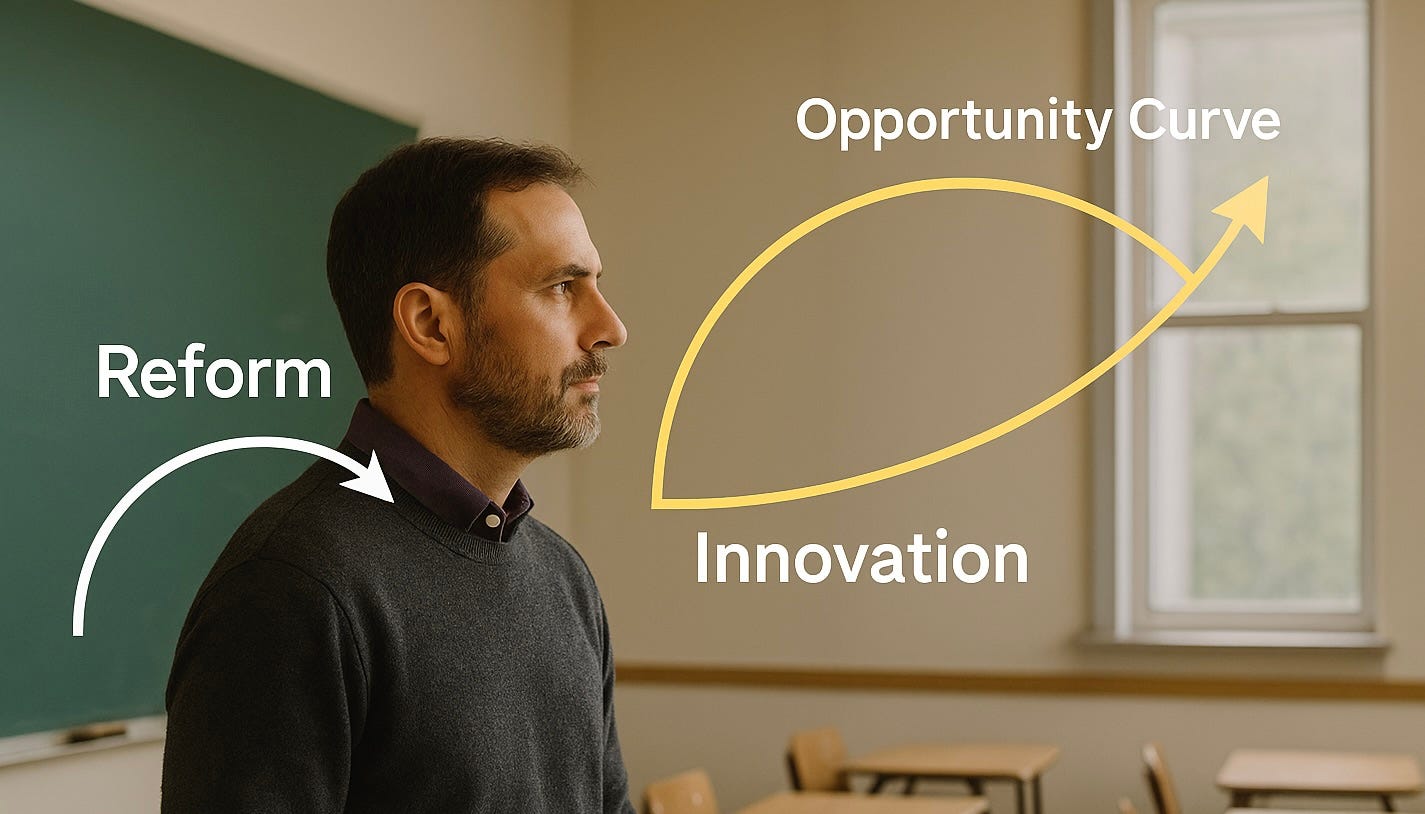
“Reform reshapes the past. Innovation imagines the future.”
Reform looks backward. It dissects the past, identifies what went wrong, and tries to fix it. At its best, it re-forms what was. But what I was really looking for—what learners needed—wasn’t just a better version of the past. It was something new.
It was innovation.
Aha! #2: The Grading Game
Back in the classroom and later in work with teachers and districts, and then as a teaching high school principal, I poured energy into improving the way we assess students. I tried alternatives: performance tasks, project-based learning, self-assessment tools. I explored what others across the country were doing.
But over and over, one pattern held true:
Everything still flowed through the same A–F pipeline.
“No matter how I reweighted or reworded, I was still sorting kids into the same buckets.”
The students asked the same questions:
“What’s my grade?”
“Will you take points off if it’s late?”
“Can I retake that test?”
“What can I do for extra credit?”
They weren’t engaging with learning. They were managing the game. And the system, no matter how well-designed, kept inviting those questions.
Aha! #3: Proficiency Isn’t a Grade—It’s a Trajectory
Thanks to my long-standing involvement with ACTFL (the leading professional organization of world language teachers) and NCSSFL (National Council of State Supervisors for Languages), I had a front-row seat to the Proficiency Movement in language education.
And it changed everything.
“Instead of students asking ‘What grade did I earn?’ we began asking, ‘What can you do with the language?’”
The ACTFL Proficiency Scale doesn’t measure how well a student matches instruction. It asks: What can this learner do with the language?
It’s not tied to curriculum, age, method, or grade level. It’s a forward-moving scale from Novice Low to Distinguished, and learners move along it at their own pace. (And here’s an important elements — no student will get to Distinguished in a high school class.)
Add in the Can-Do Statements, and you have a model that’s not only fair—it’s freeing.
“No more points. No more averages. No more failure. Just progress.”
A Living Example: FILL in Action
Here’s what it looks like in real life:
In Delaware, a Spanish teacher is using what we call FILL—Facilitated Interdependent Language Learning.
👉 Read more about the classroom here
“The teacher is no longer the grader-in-chief. They’re a guide for each learner’s journey.”
Instead of grading students on how well they match instruction, the teacher becomes a facilitator. Each student sets personalized goals and takes the next step on their proficiency journey.
There’s no “mastery of Spanish II.” There’s Marianne, progressing in her ability to read, speak, write, and understand Spanish—and Mr. Tolman, helping her along the way.
Aha! #4: Enter AI—Your New Learning Companion
Now imagine scaling that.
Every learner working at their own level. Each one pursuing their next growth point. Not tied to grade-level curriculum, but supported by feedback, tools, and time.
“What if AI made personalization real—not just possible?”
Think of what AI could offer:
Personalized prompts and feedback
Scaffolding based on proficiency level
Self-assessment support and reflective feedback
Content aligned to learner interest, identity, and goals
Now you’re not just reimagining grading. You’re reimagining learning itself.
So What’s the Real Innovation?
If you want to ride the innovation curve, stop tweaking your grading system.
“The problem with your gradebook isn’t the formula. It’s the purpose.”
A student doesn’t need a grade to grow. They need a path.
An “A” shouldn’t reward compliance—it should represent capability.
Let go of the grading game.
Let go of “fixing” your system.
Design a new one.
With different assumptions.
And a different end point.
—NB: As with all my posts, this one was the result of an iterative process using various AI apps. Image was created using ChatGPT then edited.
For some ideas or help in moving from reforming your grading to innovating an assessment approach for you students, just let me know.
As I approach the final grading session of the year, these thoughts have been rattling around in my head. Another thoughtful post. Thank you.
The ‘why’ is so compelling and the ‘how’ is becoming clearer and clearer. Great job, Tom.