The Passenger's Dilemma
We've been shoved on a train we didn't see coming

Before I return to primarily sharing my thoughts about learning and education and the shifting landscape in that ecosphere, I wanted to take a pause. I read about AI all the time. I experiment with the latest updates for software I’ve been using for two or three years and I explore new offerings. Oh my goodness – I can’t help but marvel at how wonderful so many of them are for helping me do what I’ve been doing.
However, unless you are purposely hiding under a rock or completely off-grid, you can’t escape the discussions and debates around AI. It has permeated every aspect of our lives and with the introduction of LLMs, such as ChatGPT, it has gone from a force mostly operating in the background to an anthropomorphic neighbor who has barged in the front door and is now seated squarely in our living rooms and even our bedrooms. Initially I considered AI through my education filter. But now it seems that nearly every news article, every review of the arts, every report from the current battlefield is AI- connected. Watch a news report? It may have been written by a Chat bot – in fact, you may be watching an accompanying video that was totally AI-generated and it will be up to you to determine the basis in fact. Watch a movie, listen to a hit song – yes, by now you know there was probably AI involvement to some degree either in the extras on screen or the algorithm used to write the music.
AI and all the implications—baggage, in the most pejorative sense—scare the shit out of me. For decades one of my most fundamental ideas is that of balance in the universe. It’s not just an ideal, it’s closer to a demand in my view. For every wonderful thing, there is an equally negative or disastrous one to balance it out. I could make a long list of the wonders I’m grateful for in my life -- and it would be a never ending list because I am tremendously grateful for my life and the people, products and perspectives it includes. But I am also very aware of the balance that has been demanded
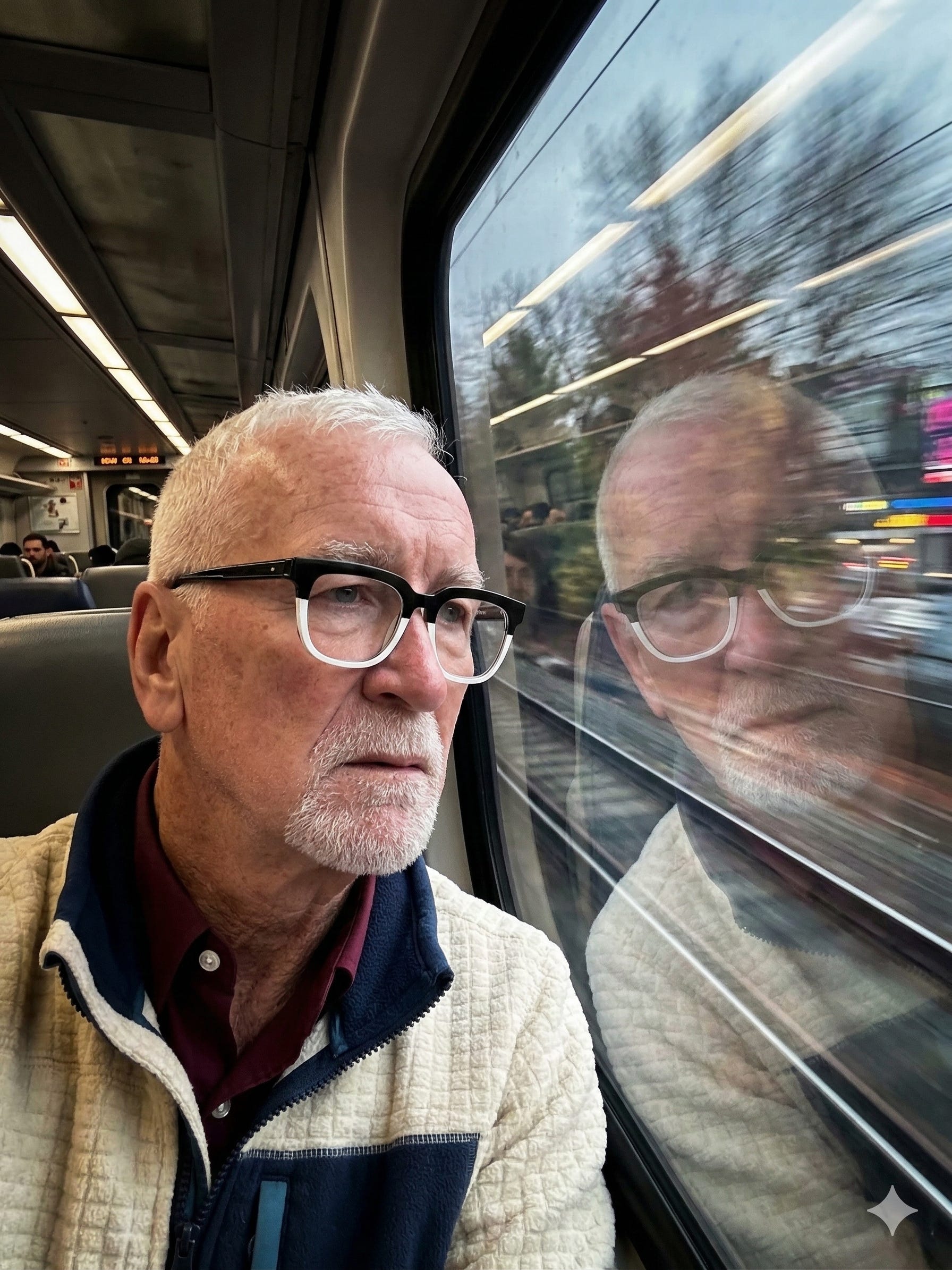
.
That’s how I view AI -- but one of the most exciting/terrifying elements that it has introduced into the balance equation is speed. I remember the first time I rode a high speed train in Europe. It was amazing to look into the distance and see how incredibly quickly the countryside seemed to be moving by. But it wasn’t the countryside that was moving, it was me. When I refocused from the distant view to the view next to the tracks I couldn’t hold focus. It was mesmerizing, then dizzying, then nauseating and I had to switch my view to the distant landscape again. AI has us all on a sort of high speed transport. The problem is that we were all hustled onto the train when we thought we were just going to work again on a normal Thursday on our regular bus route that stopped every 2 blocks. Not only did we open our eyes and realize we were on this modern marvel of a train, we also started to say “Wait! I was just going to work downtown, and now I’m moving at 180 mph through a land I no longer recognize and worse yet, I have no idea where I’m going to end up -- except the only thing I know for sure is it’s not going to be where I had been going.”
I really don’t know where this is going. I was hustled onto the train. I’ve moved through dozens of different cars as we’ve been speeding along and I’ve really enjoyed meeting other people on the train. I’ve made some plans to meet in the dining car after a while, but when I looked outside again, I saw that even the distant landscape is no longer recognizable/ A sense of dread is creeping in because I have this feeling that I may not like where we are going.
It’s the passenger’s dilemma.
NB: If you read my last post, Unvarnished truth, you know that my Substack posts going forward will be (mostly) unvarnished. This is me, my voice, no heavy AI “makeup”. I will admit that I had a long, detailed “conversation” with ChatGPT, telling it exactly how our relationship has changed going forward and let it review the post. I told it that the only help I wanted was in the case of something really glaring, or to correct basic spelling and grammar errors. The response was to promise to look it over with only a “lint brush” in hand. So this post is exactly as I wrote it — with the exception of a suggested comma, and a corrected verb tense. Actually, as I was giving this a final read before posting, I made a couple of other minor style changes that an AI “frienemy” would have surely dispatched without a thought.
The writing is all mine but the picture was generated with Nano Banana from the same selfie I used last time.
It would mean a lot if you were to give me some feedback about this more authentic style.
Feedback: most people seem to find shorter paragraphs less daunting to read. Large blocks of print are harder to read. It's a symptom of a faster-paced lifestyle, and attention-switching, caused by our fixation on 'instant, convenient everything'.
I think that's one reason AI, especially ChatGPT, uses the paragraph formatting it does.
We're coming up on scholarship season in our districts where we choose to whom we dole out dollars to impact their futures. I'll read this year with that suspicious eye trying to gauge if it is the student speaking or some digital composite.
I used to have to do that when I judged science fair projects. Vividly remember, now this was over 40 years ago, stepping up to one student whose display board was just cardboard crudely folded and written in crayon with some muddled containers sitting on the table in front of it. I don't even recall what the topic of the research happened to be. The next project was on neatly constructed and hinged plywood painted a brilliant white and the words were very neatly stenciled, remember, 40 years ago, research findings.
So which learner got the most our of "their" work? You be the judge.
My son was in the Boy Scouts, he's 41 now, and one of their father-son projects was the Pinewood Derby car. Project is filled with all sorts of opportunities for learning but the kids were just too young to grasp them. I tried to reel in my science teacher background and explain this and that hoping to lead him to the "correct" decision without flat out telling him what to do.
As with the science fair example earlier some cars were screaming "DAD" all over it; fancy enamel paint, planed down to a "sled" like look and perfectly weighted. My son's car was a fluorescent green with some pretty roughly sanded edges and a bit blocky looking. Who was the winner?
Another teacher-friend called me years ago, probably 40, and bemoaned the chase for valedictory honors. The competion was taking foods, lifetime sports, an aide period and was certainly going to score well in the gpa category during her year. The daughter was taking physics, anatomy and physiology, one upper level math class or the the other and might suffer some gpa-wise due her class choices.
The discussion eventually got to the point of asking "does she want to win the battle or win the war"? She chose to stay on the high road and was still successful in still having to write a valedictory address. By the way, she had DPT after her name nowadays!
We all get stymied by choices and AI has made us have to make them at warp speed these days and I'm not at all certain we as a species are ready for it!