When the Topic Stops Being the Target
Learning to reason with the past in a FIL classroom

I’m going to talk about history today, so I’ll begin with a bit of my own.
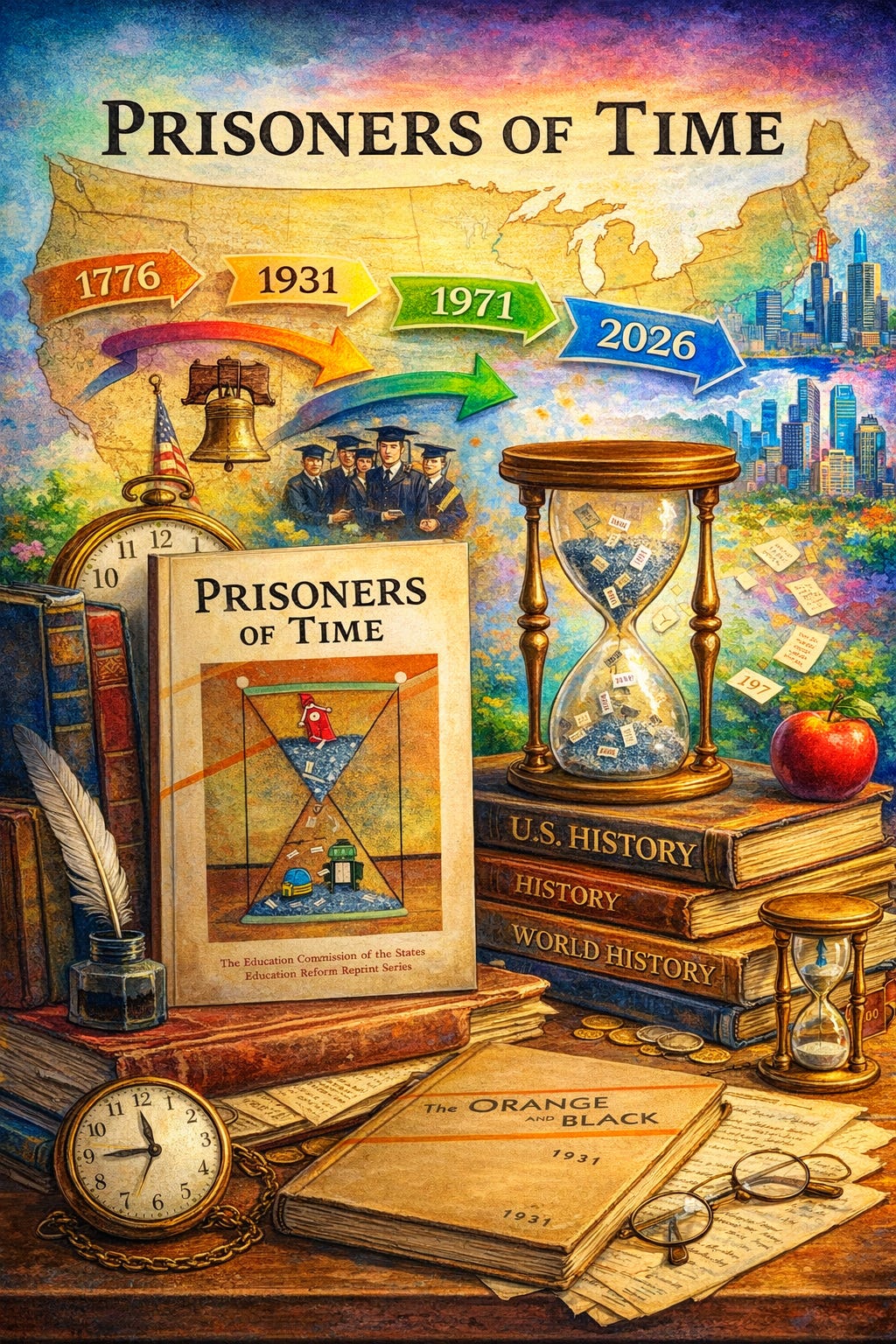
In 1994 I read a publication from The National Association of Secondary School Principals (NASSP) titled Prisoners of Time. In the introduction to its 2005 re-publication the authors observed that despite enormous changes in technology, demographics, and the economy, the amount of time students spend in school had remained essentially unchanged throughout the twentieth century. Now, two decades after that re-publication and three decades after the original report, the statement still feels accurate.
Let me give a small example.
When my mother graduated from high school in 1931, her yearbook schedule shows approximately hour-long classes and about the same length school year we have today. Roughly 180 class periods were devoted to U.S. History. To oversimplify, think of it this way: 1931–1776 meant about 155 years to cover in 180 days.
Forty years later when I graduated, there was still no additional time given to the course despite everything that had happened in between. Now it was 195 years in 180 days.
Now almost a century later, guess how much time is still typically set aside for U.S. History? The same. 2026–1776 gives roughly 250 years, so the challenge hasn’t changed — the teacher must simply compress more years, events, and people into identical time.
Mysterious or ridiculous — I’ll let you decide — but the consequence is obvious. Every generation drops topics that previous generations once considered essential. And that realization matters, because if topics can disappear without society collapsing, they were never the true objective of the course.
The hidden goal we never named
In an earlier post when discussing assessment I talked about the decisions teachers constantly make about what to include and what to let go. That was prompted by a Substack post from a professor reflecting on alternative grading who concluded he had to “pare down” the amount of covered material in his course from earlier terms. My reaction wasn’t disagreement. It was sympathy for the earlier students whose grades depended on mastering topics the teacher later decided weren’t even necessary. Imagine having your GPA affected because you didn’t know something that semester that the teacher decided this term wasn’t even important enough to include.
That points to a deeper truth. Those topics were not the learning. They were the vehicle for the learning.
History teachers have always wanted students to evaluate sources, analyze change, and understand consequences, yet students often experience something different: days of information followed by a number at the top of a test. Too often those real goals were never the focus and if students got them, it was by default and not by design. By design or by default makes a difference. When the abilities remain implicit, students understandably conclude the memorized material is the point.
An early attempt I didn’t yet understand
Years ago I taught a single World History course while serving as a teaching principal. I told students I believed there were certain important dates every educated person should know — not because the dates mattered by themselves, but because they helped me connect past to present.
I chose twenty dates that I thought were important. Then students divided into groups of five, researched, and proposed twenty more for members of their particular group. Each student then chose ten individually and justified them to the class in an oral presentation. Consensus mattered because the group’s choices had to be unanimous. Reasoning mattered because justification was required. Presentation mattered because ideas had to be communicated publicly.
Looking back, I realize what I was trying to accomplish. I wanted students to see history as relationships and consequences rather than isolated facts. I just didn’t yet have language for it. Another case of by default, but not by design.
The path through languages and math
The last few posts have explored changing where learning lives.
In languages, once the goal became what a learner could do with the language, chapters lost authority and students no longer needed to move together through material. They could move individually through growing ability.
In geometry, structure didn’t disappear; it shifted. The emphasis moved from procedures toward the habits of a mathematician — representing, modeling, justifying, revising — and the content became the setting where thinking happened.
Now we arrive at social studies.
For today’s examples I used Delaware’s standards, though you could open those of any state and see the same pattern. Teachers understandably feel responsible for carrying history forward. We all carry a mental list: the Constitution, the Civil War, the Gilded Age, the Cold War. If students don’t encounter them, something feels lost.
So instead of removing anything, begin somewhere quieter. Have students start by reading the standards — not the textbook and not the calendar in the syllabus, but the standards themselves.
When they do, something unexpected begins to happen. The goal is not for students to “know history” in the usual sense. The goal is to help them learn to think historically. The emphasis falls on analyzing change over time, evaluating sources, comparing interpretations, building arguments grounded in evidence, and connecting past to present. That happens when students start with the standards rather than a curated list of dates and events.
The discipline has always been defined by abilities. We simply organized school around topics because counting errors is easier than assessing thinking.
The Gilded Age reconsidered
Picture a typical beginning to a U.S. History unit. The teacher wants to include one of his/her favorite periods – the Gilded Age. Industrialists, labor unions, immigration, political machines, reform movements — coverage progresses steadily, yet understanding varies widely from student to student. Some remember details, others fragments, and a few remember reasoning.
Now change nothing about the topic, only the target. The Gilded Age stays, but now becomes a place where students practice being historians. The focus shifts from recounting events to weighing evidence and understanding disagreement, from recalling dates to explaining consequences. Carnegie and unions and immigration remain, but they no longer function as the destination of learning. The past becomes a laboratory for thinking using an historical perspective.
Where FIL enters
At first everyone studies the same phenomenon so the class learns what historical thinking looks like in practice. Then the structure loosens while the teacher makes sure that it’s the expectations that remain steady. Students stay within the same era but pursue different questions: labor strikes, urban housing, westward expansion, advertising, sports and leisure.
Different stories require the same intellectual work. Each learner analyzes sources, explains cause and effect, and supports claims with evidence. The class becomes synchronized not by information but by practice — shared abilities, individual pathways, the teacher facilitating rather than directing each journey. That is FIL, Facilitated Interdependent Learning.
Why this changes the discipline
Languages had proficiency scales. Mathematics had practices. Social studies had neither made visible to learners, so chronology quietly became the organizing structure. Yet the standards were never chronological documents; they described disciplinary thinking, and we treated the examples as the goal.
Once students understand what historians actually do, a new period isn’t new material to cover but another environment where the same reasoning deepens. Students are not memorizing the past. They are learning how to reason with it, and that prepares them for a future beyond 2026 that no timeline can predict.
In the next post we’ll take the next step. Up to now the teacher has still framed the historical question and students have worked within it. But what happens when learners begin asking their own questions inside a shared period of history? Surprisingly, the rigor does not loosen — it sharpens — because the moment a student must justify why a question matters, the past stops being an assignment and starts becoming evidence.
NB: I use AI while writing these pieces — not to produce finished thinking, but as a thinking partner. I move through many iterations, testing wording, challenging assumptions, and reshaping ideas before settling on what you read here. The judgments, interpretations, and any mistakes remain mine.
Writing here is one way I think. Working directly with educators is another. If you’re exploring questions around assessment, learner agency, or how a course might shift from coverage to capability, I often work alongside teachers and schools as a thought partner rather than a presenter. Sometimes a single conversation helps clarify the next step.
You’re always welcome to reach out.
While understanding, and agreeing, that the current system of testing to points is flawed, and the FIL process may open better avenues to learning, I question if there is actually any “1 size fits all” solution.
In my work experience, I have found that people have different ways of visualizing a problem, and similarly, different ways of solving the problem. In many cases, diametrically opposite ways — so opposite that both sides have trouble comprehending the other.
I remember that in school, there were students that could ace any standardized test (me) and those that struggled. On the other hand, those students could ace essay exams, while those like me struggled to collect our thoughts well enough. We all knew the topic, we had studied and practiced, yet when it came to execution, the differing ways our brains work affected how we performed.
Is there a way for FIL and the current system to co-exist? Or be combined together to accomplish the overall goal?